
Defining the Pixel-Level Conflict in Bracketed Merges
A three-frame bracket captured at -2 EV, 0 EV, and +2 EV serves as the standard baseline case for evaluating motion artifacts in high-contrast scenes. Designating the 0 EV exposure as the reference frame before initiating any merge gives the software a fixed point against which to evaluate the surrounding files. The processing engine begins by registering every exposure to the same static detail across the frame, so the underlying architecture of the image aligns. It then examines identical coordinates within the moving regions to detect discrepancies. A pixel becomes a de-ghosting problem only when scene content physically shifts between frames.
Inspecting source and merged files at 1:1 magnification reveals the core issue separating true motion from digital artifacts. True ghosting follows displaced subject geometry, creating recognizable overlapping shapes that mimic the physical structure of the subject. Sensor noise changes randomly across the frame without forming a coherent leaf, branch, or ripple contour. Foliage and water present severe difficulties for these algorithms because multiple contours cross the same local pixel neighborhood between exposures. Translucent leaf margins and reflected highlights contribute only a fraction of the recorded luminance, complicating the merge process. The software must decide which exposure provides the most accurate representation of a semi-transparent edge without introducing artificial halos.
The Mechanics of Shutter Gaps During Gusts
The capture chain unfolds in temporal order rather than acting as a single tripod-stable event. The first shutter opens, a leaf turns in the wind, the shutter closes, the camera advances to the next exposure, and a water ripple shifts position. Consider a base exposure of 1/15 second. A -2 EV, 0 EV, and +2 EV sequence requires 1/60, 1/15, and 1/4 second exposures at a fixed aperture and ISO. The shutters alone span roughly one-third of a second before mechanical release and processing delays are counted.
A five-frame bracket spaced at 1 EV records four inter-frame transitions instead of the two transitions found in a three-frame bracket. That creates many more opportunities for a leaf edge or specular reflection to change position during the sequence. Leaf-edge blur occurs during an individual shutter interval as the subject moves while the sensor records light. Displaced contours generate between those intervals as the subject settles into a new position before the next frame begins. A final merge can contain both defects within the same small branch. Photographers face a strict trade-off in these conditions. They must protect highlight detail in the sky or water while accepting smeared midtones in the moving regions of the frame.
Decision Logic Across Three Processing Engines
Evaluating three distinct processing engines requires the same aligned source stack, reference exposure, crop coordinates, and output bit depth. Engine A uses motion-threshold rejection. It flags a pixel when its luminance deviates from the reference frame. A threshold engine evaluates luminance after accounting for the exposure offset. Without this calculation, the intentional two-stop brightness difference would register as motion and trigger unnecessary de-ghosting.
Engine B relies on reference-biased processing. This approach preserves one continuous leaf edge by copying that edge and its nearby texture directly from the chosen source exposure, even when other frames contain cleaner tonal information. Engine C applies patch-based consistency checks. It compares a small neighborhood rather than a single coordinate, which protects repeated vein or ripple structures that might otherwise be broken apart. A patch spanning both the sky and a translucent leaf edge may be assigned as a single region, occasionally leading to blocky artifacts.
Running each engine twice—first with the middle exposure as the reference, then with the sharpest moving-subject frame as the reference—isolates the algorithmic behavior. Leave alignment, tone mapping, sharpening, and noise reduction unchanged during this test. These comparisons only hold as far as bracket spacing and subject speed relative to the shutter interval allow.
Reading Edge Continuity and Water Highlights at 1:1
Matching crops require reading from the contour inward to evaluate the success of the merge. The initial pass checks whether the leaf or ripple maintains one continuous boundary. A second pass verifies whether the texture immediately behind that boundary survives the processing. At a leaf edge, two narrow parallel contours indicate that more than one temporal position survived the merge. A bright or dark rim lacking a second contour points toward blending errors or local tone discontinuity.
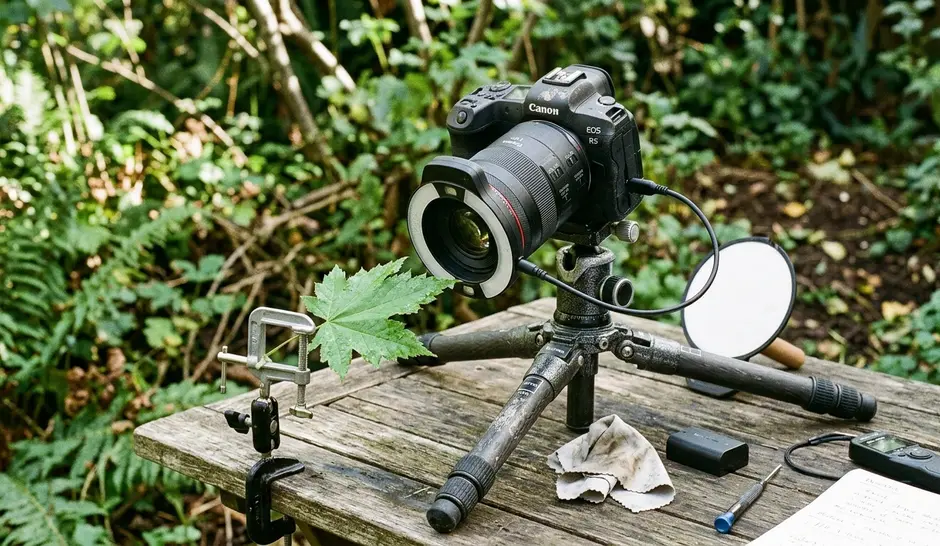
A reference-heavy result usually retains one decisive leaf silhouette. The texture inside the moving leaf often becomes flatter than the texture in stationary leaves beside it. Water behaves differently under these algorithms. On water, short-exposure source pixels can preserve narrow ripple crests and compact specular points. Longer-exposure contributions produce broader streaks that may appear tonally smooth yet lack the original highlight separation.
Comparing the same crop at 1:1 and 2:1 magnification isolates these issues. The first view reveals whether the defect matters at the native-pixel scale. Move to the second and one-pixel contour breaks and alternating bright-dark seams become immediately obvious.
Field Capture Habits That Reduce Algorithmic Load
Engine choice follows the subject rather than a universal quality ranking. Dense canopy favors a method capable of maintaining local neighborhood consistency across many overlapping edges. Open water with specular highlights demands strict luminance thresholding to prevent blown-out reflections. For a two-frame merge, manual source selection is relatively direct because each disputed region has only two temporal versions. Three- and five-frame stacks present additional edge positions and more possible luminance matches, increasing the complexity of the manual edit.
Use the camera's fastest reliable bracket sequence to minimize the time between frames. Disable any delay that is unnecessary on a stable tripod. Verify the actual capture order, as some cameras record dark-to-bright while others follow a configurable sequence. One reliable habit is timing the release for a visible lull in the wind. Watch the subject through the full sequence rather than only at the first shutter actuation. A gust beginning during the final long exposure can damage the frame carrying most of the shadow information.
Masking Complex Canopy Boundaries
A tripod-stable bracket can still fail locally when a branch changes direction between frames; global alignment does not reconcile the branch's separate temporal positions. The sharpest reference frame may preserve foliage but clip a water reflection, while a darker reference may protect the reflection and introduce blur from a longer neighboring exposure.
Manual masking remains preferable when one small moving region remains defective but the automatic pass has already preserved the rest of the frame. Select the sharp source exposure, mask along the stable side of the contour, and feather only enough to avoid a cutout edge.
Edge Custody and the Final Merge
The final inspection isolates one wind-tossed leaf against a contrasting background and traces its boundary through every source frame. If no two exposures place that boundary at the exact same coordinates, the engine must invent or discard contour information for the entire local region. Semi-transparent margins complicate the decision. An edge pixel may contain both leaf and sky data. Copying it onto a differently positioned contour produces a pale fringe even when the central leaf texture remains sharp.
Inspect edge custody before applying global tone mapping. Identify which source exposure supplied the contour, then check whether the adjacent texture and background originated from the same temporal position. A clean single leaf edge is not sufficient evidence of a successful merge if nearby veins have been flattened or the background carries a bright-dark seam. A leaf boundary displaced by even one source pixel changes which side of the contour supplies foreground color and which side supplies background color at that exact coordinate.









Reader Comments
The conversation starts with you.
Your Comment