
There is a quiet orthodoxy in bracketed photography that says the merge should never announce itself. Every tonal move should hide, every transition should dissolve, and the finished frame should pretend it came from a single perfect exposure. I want to argue against that reflex — not because seamless work is wrong, but because the drive toward it has quietly narrowed what we allow ourselves to make.
High Dynamic Range Defined as Intentional Excess
Before we can talk about style, we have to separate two problems that get collapsed into one word. HDR is not a look. It is first a capture problem and only second an aesthetic decision.
The capture problem is straightforward. A practical static-scene bracket might hold three or five raw frames spaced one to two EV apart, with camera position, aperture, focus, and white balance locked. The least-exposed frame protects the important highlights; the most-exposed frame carries usable shadow detail. Together they establish a luminance span wider than any single frame could hold. That range exists as data. It has no opinion about how it should look.
The aesthetic decision comes after the merge, when tonal mapping determines how that range fits into a display image. This is where I part ways with the seamless crowd. Stylistic HDR usually pairs global highlight compression with smaller-radius local contrast and micro-contrast, so surfaces and light transitions feel heightened rather than exposure-neutral.
Call it intentional excess. The eye reads the result as more than documentary, and that surplus is the point — not a flaw to sand away.
How the Natural-Look Mandate Took Over Bracketed Work
The preference for invisibility did not descend from a theory of human vision. It grew from delivery pressures.
Wedding work had to keep skin believable. Real-estate photographs had to render rooms legible without distortion. Landscape markets rewarded frames that looked plausibly unmanipulated. In each case the seamless treatment made commercial sense, and over time it hardened into a default brief nobody remembers choosing.
Consider an interior. The seamless approach balances window frame, wall, and exterior view so no transition advertises the merge. Reasonable enough. But the same controls that hide the seam also suppress the glare that made the room feel dramatic in the first place. You walked in and the daylight stabbed through the window; the balanced version tells you nothing about that.
Halo avoidance follows the same logic. Controlling brightness at rooflines, tree branches, veils, and window mullions is genuinely useful. The trouble starts when every visible tonal intervention gets treated as a moral failure. That fear breeds weak edge separation and cautious midtones. When every bracket set is graded to resemble one carefully exposed frame, differences in storm density, reflected light, and interior-to-exterior tension collapse into ordinary tonal balance.
Natural stopped being a creative choice and became the shape of the brief itself.
Hyper-Realistic Mapping as Emotional Language
I work backward from memory. Before touching the file, I name what I remember most strongly about the scene — pressure in the clouds, glare on wet pavement, a dark room opening onto hard daylight, and I map the bracket around that sensation. Extreme tonal mapping, treated this way, becomes a vocabulary for weather, memory, and intensity. It stages mood the way a color grade stages a film.
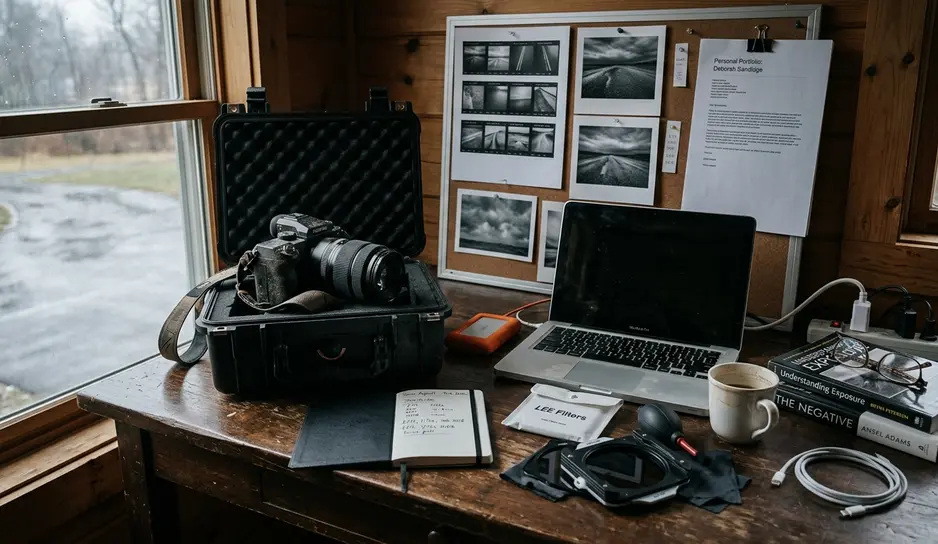
Where bold mapping clarifies intent
Some scenes practically ask for it. For storm light on wet asphalt, I hold the brightest reflections just below featureless white while opening the road enough to reveal broken reflections, tire sheen, and pooled water. The pavement becomes a second sky.
For an interior facing a bright window, I preserve the window's luminous dominance rather than equalizing it with the room. Furniture and wall texture emerge, but indoor and outdoor light never read as equally strong — because they weren't. During blue hour or the slide into night, neon needs a different discipline: stabilize the sign's hue first, then increase midtone separation in the surrounding architecture. Push the channels too hard and the colored tubes clip to flat white cores.
A useful emotional pass takes roughly ten to twenty minutes after the merge. Identify the dominant sensation, set global compression, shape two or three important luminance zones, then inspect the edges at high magnification. That last step is not optional, and it is where restraint lives.
What the Purists Get Wrong About Fidelity
The counter-argument deserves a fair hearing, because plenty of HDR does look dated, plastic, and dishonest.
Here is what I concede. A failed hyper-real treatment makes unrelated surfaces equally emphatic: cloud texture, skin pores, brick joints, and shadow noise all compete at the same visual volume. Preset damage is easy to catalog — equal brightness across unrelated planes, saturated shadow noise, dark seams beside bright objects, and foliage whose micro-contrast resembles wire. These are real, and they are ugly.
But they are execution failures, not evidence that heightened mapping is illegitimate. The distinction is between indiscriminate preset behavior and authored, scene-specific mapping. A restrained color pass can leave hue and saturation comparatively stable while luminance masks reshape clouds, masonry, water, or interior surfaces. The image can be bold in structure and quiet in color at the same time.
There is also a fidelity myth worth puncturing. Even a standard camera JPEG carries a tone curve, sharpening, color rendering, noise reduction, and highlight handling. HDR does not introduce authorship. It exposes more of it.
Critical Insight: Documentary, forensic, and other evidentiary work does require restrained, reproducible rendering, because conspicuous local remapping can blur the line between recorded detail and interpretation. Personal and fine-art work owes no such contract — and confusing the two is how the natural mandate spread past its proper scope.
Working Extreme Tonal Mapping Without Losing Structure
Boldness without structure is just noise. The order of operations is what keeps aggressive mapping from falling apart.
- Verify the bracket endpoints. The least-exposed frame must hold the highlights; the most-exposed frame must carry usable shadow. Shoot raw with fixed aperture and focus, varying only shutter speed so depth of field never shifts between frames.
- Align, then deghost selectively. Inspect leaves, water, flags, people, and cloud edges after alignment. Moving foliage and water need different deghosting decisions from static architecture; a single automatic setting can produce transparent leaves, repeated ripples, or hard-edged patches. Confine the correction to those moving regions.
- Map globally before local. Establish global highlight compression first, then add small-scale clarity or structure through masks.
- Protect shape with luminosity selections. Use them to guard specular highlights, deep shadow texture, and bright edge transitions.
Keep the merged master in a high-bit-depth working file while making major tonal moves. Repeated strong curves in a low-bit-depth file will expose banding in skies and smooth walls — a failure you cannot undo later.
Color stays protected throughout. Hue holds stable while midtone separation does the heavy lifting; luminance structure matters more than saturation spikes. And there is a place to stop. When micro-contrast starts inventing duplicate rooflines, dark rims around clouds, gritty skin, or texture in smooth surfaces that no source frame supported, the pass has gone past mapping into fabrication.
Risk Factor: The same shadow lift that reveals useful structure in a low-noise interior bracket will expose color blotches and fixed-pattern noise when the darkest source frame is underexposed. Fix the exposure at capture; you cannot mask your way out of missing data.
Shoot One Bracket Set for Feeling, Not Camouflage
Theory settles once you compare two finishes of the same capture. So this is the assignment: one shoot, two interpretations, judged by a single question.
Pick one high-contrast subject this week whose brightness range actually matters to the experience — storm-lit pavement, a dim room facing daylight, reflective architecture, or neon in the transition from dusk to night. Complete a clean merge. Save a seamless, natural finish. Then duplicate the master and build a boldly mapped version around the sensation you remember standing there.
Recommendation: Keep the shoot and both finishes inside a seven-day window so the visual memory of the scene stays available while you edit. Once the moment fades, you lose your only honest reference.
Export both at identical dimensions and output sharpening. View them side by side at full-frame size, then again at high magnification, hunting for halos, noise, and invented edges. Judge them on one thing only: whether the emotional read matches the moment you were in.
Then commit. Keep the bold version whenever its luminance structure carries the scene's weather, scale, or tension more convincingly than the camouflaged one — even if the HDR process stays visible in the frame. Make that comparison your next capture, and let the honest version win.




Reader Comments
The conversation starts with you.
Your Comment