

The Sharp Frame Is the Wrong Ambition
Photographers often begin their landscape journey obsessing over tripod-locked clarity. They chase corner-to-corner sharpness to freeze a scene perfectly in time. Intentional camera movement with ND filtration serves as a positive, deliberate aesthetic—not a failure of technique. I begin by identifying what carries the scene emotionally: the lateral pull of weather, the rise of trunks, or the spread of reflected color. I then assign that structure to three controllable levers.
A movement exposure turns a thin highlight into a continuous stroke once the shutter remains open long enough for the camera to travel visibly. The practical sequence is duration first, movement path second, and filter density third. I adjust aperture and ISO afterward to support those primary decisions.
Neutral Density as the Gate to Daylight Motion
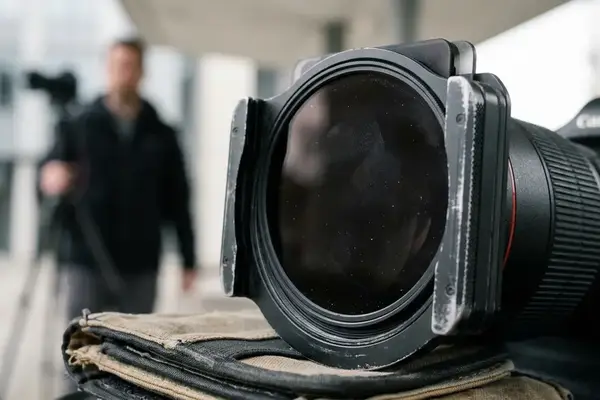
Achieving deliberate panning in bright conditions requires extending the exposure window. Solid neutral density filters provide this control for long exposure work. I meter and compose without filtration, decide whether the scene needs a restrained drift or a broad wash, and then choose enough density to reach that target duration.
A lighter filter preserves recognizable structure. Heavier stops create painterly sweeps.
The math dictates the approach. Three stops multiply the unfiltered exposure time by 8, six stops by 64, and ten stops by 1,024. An unfiltered reading of 1/125 second therefore becomes approximately 1/15 second, 1/2 second, or 8 seconds, respectively. For intentional camera movement, a three-stop filter commonly opens short drift exposures in moderate light. Six stops reach continuous-stroke durations in brighter daylight. Ten stops often extend the exposure beyond the duration of a single controlled gesture.
Managing Filter Stack Interference
Thick filter stacks vignette on ultra-wide lenses. Exposures lasting several seconds record subject motion and camera motion as separate, competing patterns.
Exposure Windows That Paint Instead of Freeze
I choose a duration by watching the scene before touching the controls. Fast wind in reeds already supplies motion, so the camera gesture remains brief. During the blue hour, calm water needs a longer sweep to build a visible effect.
Exposure windows around 1/15 to 1/4 second retain identifiable edges. Roughly 1/2 to 2 seconds form continuous strokes. Longer durations merge repeated detail into near-abstract fields — exposure bracket comparisons reveal as much.
A practical duration bracket includes 1/8, 1/4, 1/2, and 1 second. Change one variable per frame so the effect of exposure time remains readable. While these duration brackets offer a proven starting point, the same 1/2-second gesture changes substantially with focal length, subject distance, wind, and the photographer's rotation speed.
Physical Paths That Structure the Abstraction
The physical movement of the camera dictates the final composition. Horizontal pans reinforce shorelines, cloud bands, and wet-sand reflections. Vertical lifts elongate trunks, reeds, columns, and narrow waterfalls.
For a shoreline, I level my shoulders, hold the camera close, and rotate from the hips so the horizon travels laterally without bobbing. For trees or reeds, I begin below the intended composition and lift smoothly through the frame.
At the same camera speed, a longer focal length produces greater image displacement than a wide lens. A distant subject yields tighter-looking bands than nearby foreground material. Arcs, diagonals, and interrupted pauses introduce a distinct compositional grammar to the capture.
A Field Sequence From Metering to Release
Before mounting the filter, I look for two or three dominant color bands and decide which line governs the movement. I compose a sharp reference, set the exposure intent, focus, and prevent autofocus hunting by switching to manual.
A disciplined capture set contains four distinct gestures: level horizontal, slightly rising horizontal, diagonal, and horizontal with a brief central pause. Rehearse the gesture dry, then expose. Cover multiple takes with varied paths rather than identical repeats.
Structuring the Field Notebook
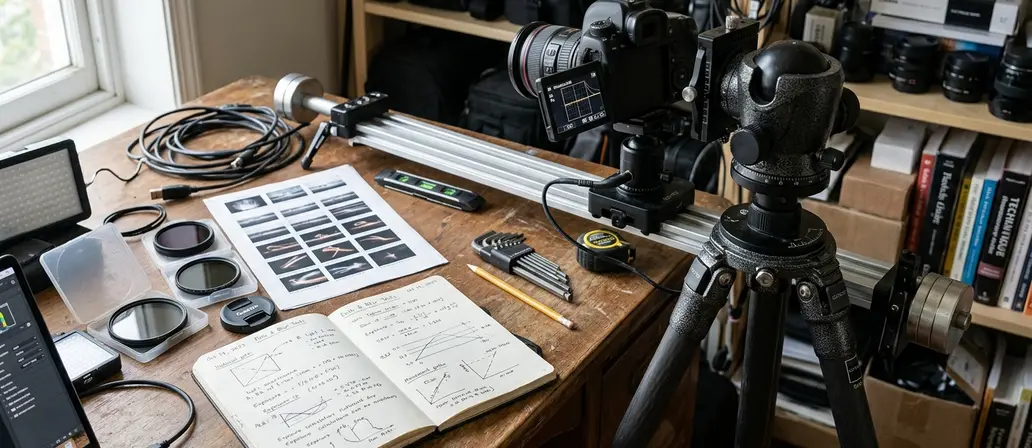
Record lens focal length, ND strength, shutter duration, movement direction, and a short result code such as 'clean bands' or 'double edge' immediately after reviewing the frame.
Color and Contrast After the Gesture
Post-processing requires protecting the soft structure of the blur. I first set white balance and broad tonal separation while viewing the image small enough to judge its color fields. The editing order is white balance, global exposure, black and white points, regional hue separation, selective texture control, crop, and restrained output sharpening.
Next, I adjust global contrast without restoring hard local edges, then use selective clarity reduction. Guide hue separation so color fields read as intentional planes rather than muddy overlaps. Tools like Nik Color Efex Pro help manage these tonal transitions. Nik Silver Efex Pro excels at mapping luminance values in monochrome abstractions.
Evaluate sharpening at the intended output size. Halos along blurred trunks or shoreline bands indicate that edge enhancement contradicts the capture.
Where Controlled Motion Collapses
When a frame feels merely shaken, I inspect the trace direction rather than adding contrast. A multi-axis shake produces hooks and doubled edges that read as handling error rather than controlled abstraction. Two or more accidental axes create zigzags, so the next exposure requires a stricter physical path.
Insufficient density forces high ISO noise into long gestures. If the unfiltered reading is 1/250 second, a six-stop filter produces approximately 1/4 second. Reaching about 1 second under the same light requires roughly eight stops of total reduction. High ISO does not solve insufficient neutral density in bright light because it shortens, rather than extends, the available exposure.
If a heavy filter makes the exposure impractically long in fading light, use less density before increasing ISO. Finally, subjects with no dominant line or tonal band resist abstraction entirely.
One Low Tide at First Light
At first light on the Cocoa Beach shoreline, the six-stop filter was already mounted as a thin wash of water withdrew across the sand. The frame contained three horizontal elements: muted blue sky, a dark horizon band, and the reflective beach.
The exposure used a 0.8-second shutter duration with one continuous horizontal camera path. I timed the gesture during the retreat of a shallow wave, when wet sand carried the sky color but incoming foam no longer divided the frame.






Reader Comments
The conversation starts with you.
Your Comment