

Cover the Glass Mid-Exposure and the Trails Sharpen
At a signalized intersection, traffic arrives in pulses. A long exposure that runs through several releases can fill the frame with red and white light trails, yet the same open shutter records the streetlamps during every pause between them. A rigid black card gives the photographer a second shutter: raise it when vehicles move through the composition and lower it when they stop.
The camera shutter stays open across successive signal phases. The card determines which phases reach the sensor. That distinction makes the method more precise than choosing one uninterrupted bulb interval and hoping the fixed lamps survive it.
Timing begins with the street, rather than an ND filter calculation. Watch which lane produces the trails you want, learn its stop-start pattern, and admit light only when that lane supplies movement. The resulting exposure may span several signal phases while containing light from only the useful parts of them.
Why a Single Unbroken Bulb Shot Cooks the Streetlamps
Consider a composition with a streetlamp above a line of cars waiting at the stop line. During an unbroken bulb exposure, the lamp illuminates the same photosites for as long as the shutter remains open. A moving taillight crosses successive photosites; its contribution at any one position along the trail is brief. Waiting through red for another wave of cars therefore adds more exposure to the lamp without adding a passing ribbon.
An ND filter reduces the light from both sources. It can extend the available shutter time, but it cannot favor moving cars over stationary fixtures. If the exposure must continue longer to gather dense trails, the fixed lamps continue accumulating light. Brake lights on stopped cars create a similar local problem: they remain concentrated near the stop line instead of drawing lines through the frame.
Inspect the brightest globes on a test frame before committing to another traffic pulse. A glowing white center, a magenta halo, or a clipped color channel signals lost highlight information. Once a channel clips, raw processing cannot reconstruct the color or edge detail that the sensor did not record. The card addresses the timing of that accumulation by blocking the stopped phase while the camera shutter remains open.
Treat Green, Amber, and Red as Your Shutter Map
Which green light matters? The one that sends vehicles through the framed roadway. From the camera position, watch a complete green–amber–red cycle before starting the exposure. A signal elsewhere in the junction may change while the lane that supplies your trails remains still, so use actual vehicle movement as the final cue.
Assign the first visible moving pulse to card-up time. When the flow slows and brake lights gather at the stop line, cover the lens. Keep it covered through red. Treat amber as a buffer: if brake lights remain stacked, amber belongs under the card even when the next release seems imminent. Raise the card again only when the next group begins moving through the composition.
This timing map suits signalized urban intersections with a readable stop-start pulse. Free-flowing motorways offer no comparable stopped phase to exclude. Even at a controlled junction, the signal alone cannot confirm that the approach has cleared; the vehicles in the frame provide the useful timing evidence.
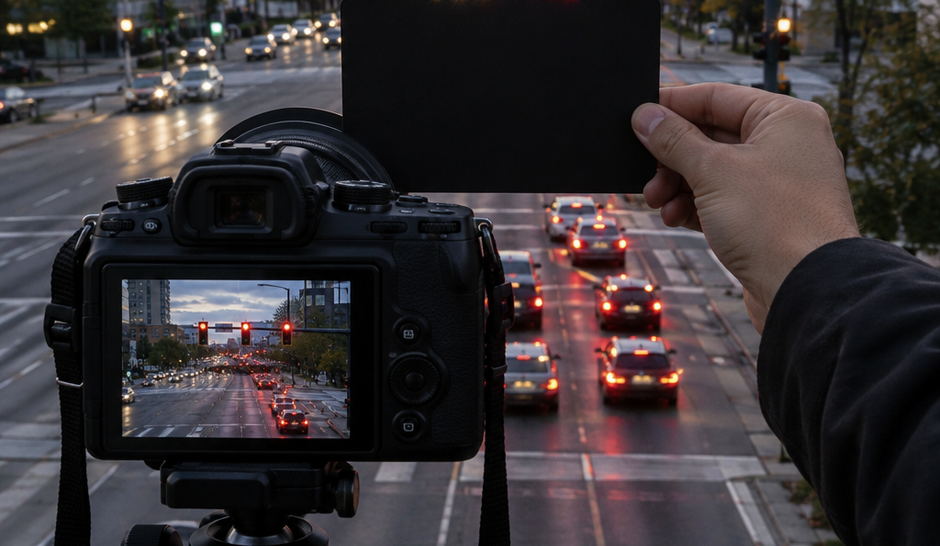
Separate two clocks when planning the frame. The camera-shutter clock runs from release to closure. The exposure that reaches a particular streetlamp is the sum of the card-up intervals within that span. Thinking in those terms helps decide whether another moving pulse is worth the additional lamp exposure it brings.
Sliding a Matte Card Across the Lens Between Phases
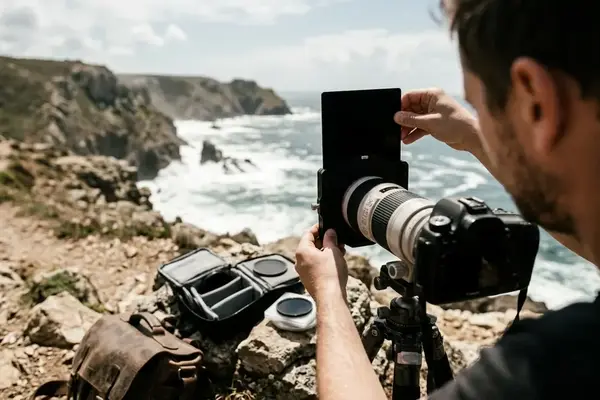
A rigid, matte black card needs to cover the entire front opening of the lens or hood. Hold it just clear of the glass so its edge cannot scratch the front element. Check that the surface and edges do not reflect nearby lamps into the lens. Its job is simple, complete occultation during the phases you want to omit.
- Lock the camera on a tripod, settle the composition, and make a test frame that preserves detail in the brightest lamp globes.
- Hold the card ready beside the lens. Open the camera shutter on bulb or a suitably long timed setting as the first moving pulse begins.
- Admit the vehicles crossing the frame, then slide the card cleanly over the opening as traffic stops.
- Keep the lens covered through the red phase and any amber period during which brake lights remain at the stop line.
- Uncover when the next pulse visibly moves, then close the camera shutter after the admitted traffic has passed.
Move the card decisively rather than waving it in front of the lens. A slow or repeated sweep can introduce uneven shading during an otherwise useful vehicle pass. Keep reflective edges outside the lens’s view and avoid lifting the card merely because a signal changes; stationary brake lights can still be stacked in the composition.
The card controls admission of light, not the camera’s recording state. The shutter remains open beneath it, so a small gap or an incomplete cover can register throughout a supposedly excluded pause. In a busy streetscape, that makes a fully covered front element more important than exact hand position to the millimeter.
Building Ribbon Color Without Haloed Lamp Globes
The intended file holds saturated red and white ribbons from successive releases while retaining shape and color around the fixed lamps. Two admitted moving pulses can build trail density in places one pass leaves sparse. A continuous take spanning the same stop also gathers those passes, but it exposes the streetlamps and waiting brake lights throughout the interval between them.
Compare the two approaches by looking at the trails, lamp edges, and individual color channels. The interrupted frame should show whether the added pulse contributed useful ribbon without pushing a lamp channel into clipping. Covering red reduces unnecessary lamp exposure; each card-up interval still adds light to every visible fixed fixture. Stop collecting pulses when the lamp approaches its limit, even if another wave of cars could make the trails denser.
Keep ISO low and choose the aperture for the lamp rendering the picture needs. A smaller opening may give pronounced star-points; another choice may leave broader disks. Those decisions shape the appearance of the lamps, while the card controls when their light reaches the sensor. An ND filter can still serve an exposure plan, but its density does not replace the decision to exclude stopped traffic.
At blue hour, the balance between ambient sky, vehicle lights, and streetlamps can change while the photographer waits for the next release. Recheck the lamp globes in the resulting frame rather than assuming an earlier test still describes the current light. The timing method remains the same: admit moving light, count the accumulated card-up exposure at fixed lamps, and end the frame before their color disappears.
The Streetlamp Occupies Every Second You Leave Open
A long exposure gathers time unevenly across its subjects. A streetlamp occupies the same image location throughout every uncovered interval. A crossing taillight may occupy a given photosite for only a few milliseconds as it travels along its ribbon; its dwell there depends on image speed and trail width, not on the duration of the whole traffic pulse.
That occupancy gap determines the final hand movement. Lower the card when traffic stops, because red continues feeding the fixed streetlamp while the passing ribbon has ceased. At one photosite, the streetlamp receives the sum of every card-up interval; the moving taillight may be there for only a few milliseconds.





Reader Comments
The conversation starts with you.
Your Comment