
Where a Single Shutter Loses the Coastal Frame
A single shutter duration can preserve the wave structure or extend the cloud movement while leaving the finished print short of the intended relationship between them. A short exposure holds broken, choppy surf beneath an apparently stationary sky. A much longer exposure draws out cloud travel while dissolving the foreground into featureless milk. The loss becomes apparent when the water and sky receive separate attention at the intended print size.
The useful reference details are specific: foam channels between waves, the boundary between crest and trough, and gaps separating cloud bands. These features establish what the photograph needs to retain and what it can allow to stretch. A pleasing overall impression on a small preview can conceal the disappearance of the foreground detail that gave the composition its depth.
A second duration allows each motion to retain its own recording interval. The water can carry recognizable ridges while the sky records sustained drift. Combining those exposures preserves motion that the camera actually recorded in each part of the scene.
The first decision therefore concerns the finished image: which wave details must remain legible, and how far should the cloud edges travel? Filter selection follows that decision.
Surf and Clouds Move on Different Clocks
Why does an exposure that gives the sky momentum so often flatten the sea? Breaking foam can change substantially within a fraction of a second to a few seconds. A cloud bank may require tens of seconds or longer to register substantial displacement across the composition. Both occupy the same photograph, yet their useful recording intervals can sit far apart.
Blur records the distance an image feature travels across the sensor while the shutter remains open. Extending the exposure accumulates more of that travel. Once the foam has crossed and recrossed the foreground during the recording interval, distinct channels merge into a broad pale surface. Meanwhile, the slower cloud edge may only be beginning to form a useful trail.
The reverse compromise leaves the cloud structure nearly unchanged while retaining the water's internal boundaries.
Observation provides the starting point. A recognizable wave should be watched through its movement, then a cloud edge tracked against a fixed landmark. Apparent cloud travel depends on wind direction, cloud distance, and focal length as well as wind speed. The duration should follow movement within the frame. At the point where the sky exposure begins to gain expressive trails, its borrowed shutter time may already be erasing the foreground's foam channels.
Secure the Water Frame Before Extending the Sky
A defined wave set creates a brief opportunity. The practical sequence records that shorter water exposure first, then captures the longer sky exposure promptly from the same locked position. Delays between files allow the light and cloud mass to move further from their original relationship.
Keep the Recording Geometry Fixed
The tripod establishes the shared viewpoint. Focal length and manual focus remain fixed throughout the pair, along with aperture, ISO, and white balance. Automatic framing or perspective adjustments that change the crop should be disabled. Stabilization follows the equipment's tripod guidance.
- Compose and meter at the selected aperture and ISO, using manual exposure and raw capture.
- Record the shorter exposure when the wave develops useful foam channels.
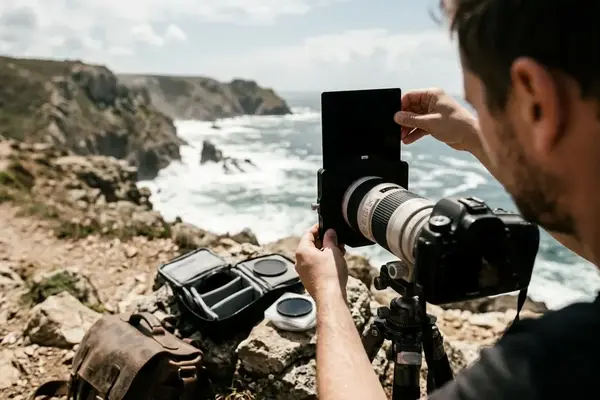
- Support the filter holder during the density change so the swap does not torque the camera.
- Record the longer sky exposure with a remote release or shutter delay.
For a first attempt, this fixed sequence keeps attention on the distinction between water texture and cloud travel. Once the sequence becomes familiar, the more demanding judgement concerns timing: selecting a wave whose channels support the composition while preserving enough continuity in the sky for the second capture.
Recording the shutter time and filter density for each file also makes the pair easier to evaluate. Those settings distinguish a deliberate motion change from an accidental brightness mismatch. Aperture and ISO stay unchanged; neutral density compensates for the longer shutter interval.
Calculate Filter Density Around the Required Durations
Each added stop of neutral density doubles the exposure time at the same aperture and ISO. This relationship makes the filter choice a calculation based on the desired motion rendering. The lighter filter serves the water exposure; the denser filter provides the longer interval needed for cloud displacement.
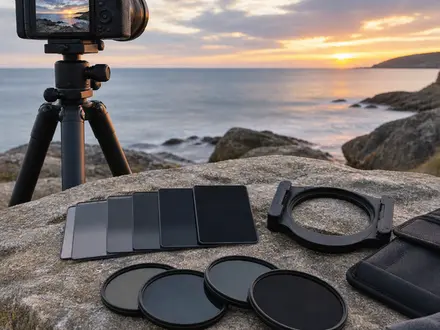
With an unfiltered meter reading of 1/8 second, a 3-stop filter gives 1 second, while an 8-stop filter gives 32 seconds. These exposures form a concrete working pair for testing retained water structure beneath extended cloud movement.
- The water frame receives the 3-stop filter and a 1-second exposure.
- The sky frame receives the 8-stop filter and a 32-second exposure.
- The five-stop density increase compensates for the five-stop increase in exposure time under unchanged illumination.
The calculated settings establish comparable brightness while allowing markedly different motion records. After each capture, the histogram and highlight warnings provide the practical check. Bright foam deserves particular attention because its detail can disappear even when the surrounding water appears comfortably exposed.
Check the Pair After the Swap
Actual filter transmission and changing light require checking the calculation against the captured files. A shift in overall brightness should be addressed during capture while the composition remains available. Leaving a large exposure jump for the mask makes the eventual transition harder to control.
The filter swap itself belongs to this calculation procedure: support the holder, keep the camera body still, and leave the tripod head untouched.
Join Shorter Water to Longer Cloud Movement
Alignment precedes masking. Matching lens corrections and compatible raw development settings establish a consistent starting point, after which stationary rock or pier edges provide alignment references. The horizon supplies a level reference. Foam, reflections, and cloud edges move between captures and should remain outside that alignment judgement.
The file with the preferred overall color and tonal relationships becomes the base. The mask then reveals the alternate exposure only where its motion serves the composition: typically shorter-exposure water beneath longer-exposure sky. Keeping this division explicit reduces the temptation to blend indiscriminately across the frame.
Keep the Horizon Transition Narrow
A sharp sea horizon calls for restrained feathering. Broad feathering can mix different wave patterns into a soft horizontal band. Around spray, the transition should follow the actual tonal boundary closely enough to preserve its irregular shape. Bright water against a darker sky deserves careful inspection for halos.
The blend also requires compatible scene geometry: if a viewpoint shift changes the foreground overlap against a pier edge, the affected pair should be recaptured from a secured position. A mask can separate recording intervals without resolving that changed overlap.
Final inspection should include the individual red, green, and blue highlight warnings as well as overall brightness. This matters where foam or waterfront lamps sit beside the mask boundary. The completed transition should preserve the edge structure and tonal relationship already present in the selected base.
Choose the Motion That Needs the Last Exposure
On an open coast, the water test usually establishes the shorter duration. The sky exposure then extends until recognizable cloud travel supports the composition. The 1-second and 32-second pair offers a starting comparison; the actual choice follows the observed foam structure and cloud displacement.
At a night waterfront, vehicle trails or moving reflections may occupy the faster role. Their desired length and structure guide the shorter exposure while the cloud movement guides the longer one. Individual lamp highlights need separate inspection because the histogram's dark bulk can draw attention away from clipped light sources.
As light fades, the next exposure becomes a choice about the finished photograph. Matching brightness alone gives little guidance; the decisive comparison concerns the motion detail each file contributes.
If fading light permits only one more exposure, which motion will be left at the weaker duration: the foreground movement or the cloud drift?










Reader Comments
The conversation starts with you.
Your Comment