
The Second Shutter at the Cypress Line
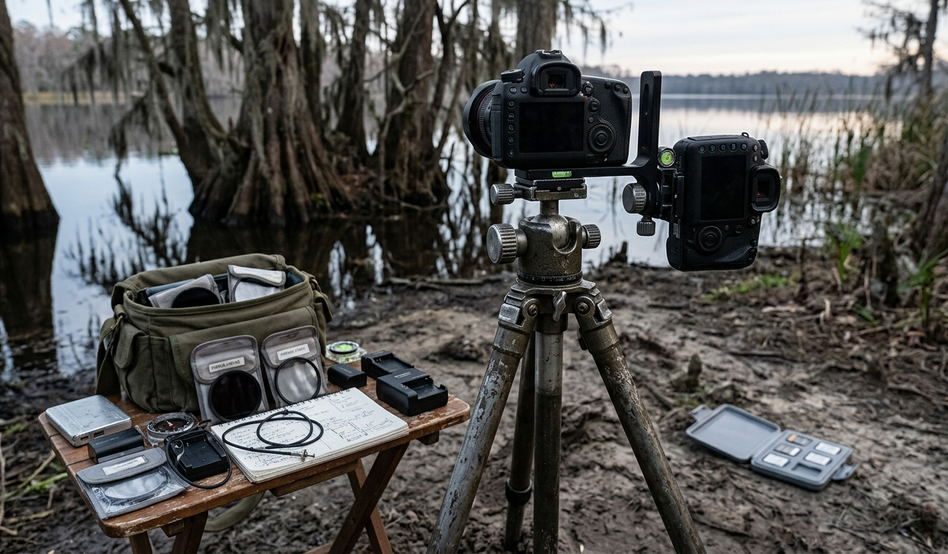
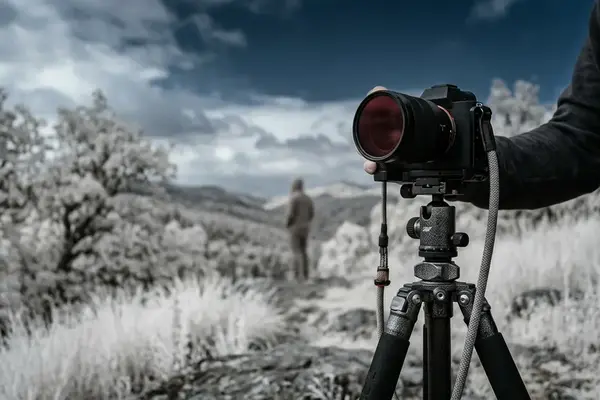
At first light, the carbon-fiber tripod stands locked at the edge of a still cypress marsh. Spanish moss hangs through the gaps in the canopy, and the water holds clean reflections before wind or wildlife disturbs the surface. I settle the composition before recording either spectrum: legs planted, head locked, focal length fixed, and the cypress line checked against the frame edges.
The visible-light RAW file goes to the card first.
That order protects the most perishable information in the scene. Cloud edges, dawn color, atmospheric haze, and specular highlights on water can change during the time required to fit an infrared filter or position a second body. The infrared canopy may still be available a minute later, but the original weather may already have passed.
One Composition, Two Shutters
- Compose the landscape and secure the tripod head, zoom ring, and focus controls.
- Expose the visible plate while the sky and reflections are intact.
- Change filtration or place an indexed infrared body at the same camera position.
- Compare the horizon with the original viewfinder marks and verify focus.
- Expose the near-infrared plate without rotating or releasing the head.
The pause between shutters carries the tension of the method. The sky remains ordinary while the canopy waits to glow, and both records must preserve the same geometry.
When Infrared Skies Go Dead
Single-file infrared landscapes often divide against themselves. Healthy leaves become pale and radiant, yet the sky contracts into a dense, low-contrast slab. Weak separation between blue atmosphere, haze, and cloud removes the visual evidence of weather.
Viewers still expect a sky to describe depth and time of day, even when the foliage has become surreal. A blue wash applied during grading supplies hue without restoring cloud structure, horizon gradation, or atmospheric distance. That mismatch often makes the print feel unfinished rather than ethereal.
Judge Sky and Leaves Separately
Review the infrared plate as two optical regions. In the canopy, inspect luminous leaf detail and the separation of branches from background gaps. In the sky, inspect cloud-edge definition, the gradient near the horizon, and the tonal distinction between open atmosphere and haze.
A weak infrared sky should be treated as a missing plate. Preserve the visible RAW file even when its trees appear conventional, because that file holds the sky gradient, cloud color, natural water highlights, and distant atmosphere. Those records cannot be recovered by assigning arbitrary color to an infrared sky.
Two Spectral Records of the Same Geometry
The method becomes clearer once each capture receives a defined optical job. The visible file supplies weather: sky color, distant haze, ordinary specular reflections, and the natural color structure of water. The infrared file supplies canopy luminance and the characteristic brightness of leaves.
This division follows plant optics. Healthy foliage reflects strongly in the near-infrared, allowing leaves to record brightly while visible blue sky remains available from a separate exposure. NASA Earth Observatory’s discussion of near-infrared reflectance of healthy foliage explains the spectral basis for this response.
The Registration Boundary
The cypress-line plate split places visible weather above and near-infrared leaf luminance below, joined through the lace of Spanish moss.
Both files must retain the same focal length, camera height, horizon placement, and entrance-pupil position. The pairing also assumes a locked camera and a largely static landscape. Wind-thrashed grasses, passing boats, birds, and wildlife create different silhouettes in the two records; those conditions require motion repair rather than an ordinary spectral blend.
The negative spaces matter as much as the branches. Once gaps between infrared twigs cease to match the visible sky, masking alone cannot reconcile the plates.
Locking the Tripod Before the Light Shifts
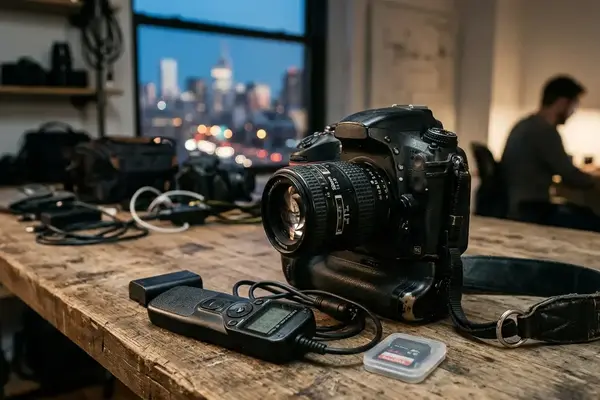
Mechanical discipline saves more composites than elaborate masking. Choose the focal length before the visible exposure, secure the zoom ring, and avoid touching the head afterward. A cable release, delayed release, mirror lockup, or electronic shutter reduces contact with the camera during each plate.
Stock Camera or Converted Body
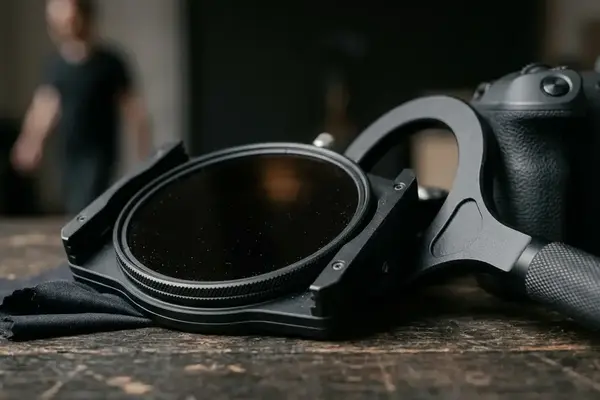
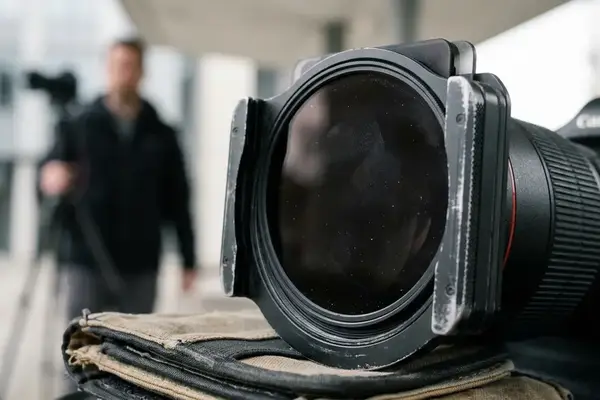
A stock camera fitted with a screw-on infrared filter offers an accessible route, though the dense filter lengthens exposure and can shift focus. Make the color exposure before fitting the filter. After installation, inspect a distant trunk or high-contrast branch at maximum review magnification, then refocus for infrared if required.
A converted body with its hot mirror removed works faster. It still needs a matched visible camera at the same position, or a second pass with the filtration reversed. Swapping bodies succeeds only when the second camera returns to the indexed composition without changing the entrance-pupil position.
Expose Each Plate for Its Own Signal
Use manual exposure and RAW capture for both files, but avoid matching shutter settings merely for consistency. Protect cloud highlights in the visible plate. Protect luminous leaf detail in the infrared plate. Set white balance separately so later development does not force either record through an extreme correction that damages mask edges.
- Compare the horizon against the same frame marks before the second shutter.
- Confirm that head locks, focal length, and focus controls remain secure.
- Review cloud contours and branch gaps in both previews before leaving.
Displaced cloud edges provide an early warning: the sky mask will no longer seat cleanly against the canopy.
Where the Color Sky Enters the Infrared File
Assembly begins as a geometric problem. Develop both RAW files without introducing different lens-profile corrections, open them as layers, and align them using fixed scene structure. Trunks, the horizon, and shoreline details tell the truth of registration; an open sky does not.
Align Before You Color
If automatic alignment becomes necessary, validate the result against three distributed regions: a foreground trunk, the central horizon, and a far shoreline. Agreement in one corner can conceal rotation or scale drift elsewhere.
Place the infrared file at the base. Its foliage luminance provides the structural reason for making the composite. Position the visible file above it, conceal that layer with a mask, and reveal only the sky, distant haze, and water that should remain optically ordinary.
Protect the Fine Canopy
Build the first foliage selection from infrared luminosity rather than a coarse visible-color range. Pale infrared leaves and fine branches already describe the boundary that must survive. Refine local edges around twigs and openings in Spanish moss so they do not acquire halos of borrowed blue.
Inspect the treeline at high magnification and again at final output size. The close view exposes edge contamination; the output view reveals whether the transition reads as a painted seam. Keep sky corrections clipped to the visible overlay so later contrast work does not flatten the infrared canopy underneath.
Luminosity Masks Against Painted Seams
Three mask sources deserve comparison against the actual plates: an infrared luminosity mask, a manually painted layer mask, and a channel-based extract. Each fails in a different part of the cypress line.
A luminosity mask usually identifies bright foliage and fine branch structure efficiently. Channel extraction can produce a cleaner boundary when infrared leaves already approach white, though it may also select bright clouds occupying the same tonal values. Painting a mask by hand offers direct control along broad horizons and solid trunks, then breaks down around lace-like branches and hanging moss.
Let Luminance Propose the Edge
I rejected a fully painted treeline because its construction became visible first around Spanish moss. The reliable approach is hybrid: let infrared luminance propose the foliage boundary, then paint only the exceptions.
- Remove power lines accidentally included with bright leaves.
- Correct pale trunks whose values overlap the foliage selection.
- Restore openings between fine outer twigs.
- Exclude bright clouds selected by a channel extract.
- Control reflected sky beneath the treeline independently.
Use local edge refinement instead of a broad uniform feather. Excessive softening spreads visible sky color over the luminous canopy and turns a spectral transition into a visible blur. At blue hour, that contamination becomes especially obvious because cool sky color gathers around every pale branch.
Fire the Color Frame First
The field order is fixed: lock the tripod and expose the visible-light frame first. Sky shape, dawn color, atmospheric depth, and water sparkle belong to a moment that cannot be reconstructed credibly after it changes. The infrared plate remains the variable because filtration, focus, or exposure can still be corrected with another pass while the camera stays locked.
Do not release the tripod head or remove the camera position until both RAW files have been reviewed for focus, highlight clipping, framing, and cloud continuity. If the infrared pass is faulty while the light remains stable, repeat that plate and retain the first visible exposure as the reference for sky and reflections.
Keep the color sky; grow the glow only in the trees.








Reader Comments
The conversation starts with you.
Your Comment