
What Happens to Seeing When the Frame Is Chosen Before Arrival?
What happens to a photographer's seeing when the successful frame is already chosen before the plane lands? Seeing turns into a likeness test. The question in the viewfinder shifts from "what is here?" to "does this match?"
The trophy shot is the image a destination is already famous for: the same overlook, the same hour, the same foreground, with success judged by resemblance to the postcard. The photographer who carries it checks position, waits for the expected illumination, and releases the shutter once the scene lines up with memory. The test runs through a short list of observable choices, namely camera position, foreground placement, horizon height and the direction of illumination. Each one has an answer before the tripod legs are even extended.
That measure trains confirmation rather than notice. The eye scans for the listed subject and treats everything else as delay: the cloud shadow crossing a terrace, the sudden warmth on a plastered wall, the gap that opens between two pedestrians. None of these appear on the list, so none of them count.
A related consideration deserves attention because it is rarely named. Confirmation feels productive. A matched frame delivers a small, reliable reward, and that reward reinforces the habit on the next morning and the next trip. Over a week of travel, the photographer becomes more fluent at reproduction and less practised at the slower skill of reading an unfamiliar place.
Borrowed Compositions That Arrive With the Itinerary
Early in my own travel work, I kept a printed sheet of reference images clipped inside a notebook cover, and I remember the particular relief of finding each viewpoint and recognising the scene. Only later did it become clear how many decisions that sheet had already made on my behalf.
Most photographers who travel with a group will recognise the pattern. A predetermined shot list imports someone else's decisions. The named viewpoint establishes where to stand. The reference image establishes the frame edges. The next departure on the schedule establishes when the morning is finished. Once those decisions feel settled, field time goes into aligning the scene with the reference, and a moving cloud shadow or reflected light on a nearby wall receives attention only if it improves the copy.
The cost is attentional, and the clock makes it sharper. A fixed departure can precede the moment direct sun clears a ridge, or it can follow the moment an illuminated wall stops returning light into a shaded street. Either way, the schedule written around a borrowed composition rarely coincides with the hours when the place itself is most expressive.
This produces what might be called the postcard-completion failure. The morning is declared finished because the foreground and horizon match the reference, while the first useful reflected light is still developing down the street. The group boards the vehicle at precisely the moment the location begins to offer something of its own.
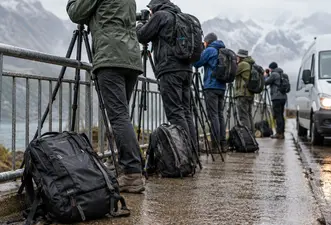
There is a crowd effect as well. Iconic sightlines concentrate people into one stance, often a few square metres of railing or rock. The frame treated as unique is therefore the one most often repeated, made from the same position, with the same lens choice, in the same light.
Watch the Departure Time
Before accepting any scheduled pickup, ask what the light will be doing in the half hour after it. If a lit wall or a ridge line is about to change the street below, the itinerary is ending the session too early.
A Brief Written in Light, Terrain, and Weather Habit
Photographers new to self-directed travel often plan by subject: the bridge, the tower, the famous dune. That approach feels concrete, and it is easy to research. Its weakness is that it says nothing about whether the light on arrival will suit the subject at all.
Moving from landmarks to relationships
The first step forward is to replace the landmark stack with a brief that names light quality, light direction, and how a place behaves under that light. Build it from relationships that can be checked on arrival: soft or hard light, front or side illumination, terrain that catches or blocks it, surfaces that return it, and ground that fills or empties as the day progresses.
Place, in this sense, means terrain, the site's weather habit, and whether the ground is occupied or empty. The subject printed on the postcard is only one inhabitant of that place. Research the weather habit in advance, then compare the expectation with the actual cloud movement, moisture and visibility once you are standing there. The gap between forecast and ground is frequently where the best working conditions appear.
A usable brief might read: "Low side light across uneven stone; watch the sheltered lane for reflected warmth and changing pedestrian spacing." Nothing in that sentence names a monument, yet it gives the morning a clear direction.
Intention versus prescription
The more advanced distinction is between intention and prescription. Intention is why you are out: the inquiry you are pursuing, such as how reflected light behaves in narrow streets. Prescription is what the frame is required to contain. The open-brief boundary is easy to see side by side. "Low side light across wet stone" leaves the photograph undecided. "This overlook, this foreground, this sunrise" has already decided it.
One caution matters here. A commissioned assignment may require recognisable landmark coverage, and agreed deliverables are not optional. Everything in this article concerns self-directed photography, where the only obligation is to the work itself.
Test the Brief Aloud
Read your brief and ask whether two photographers following it could return with entirely different pictures. If they could not, it is still a shot list in disguise.
Sequencing the Day by the Hours That Actually Change
The practical core of this approach is a different kind of scouting. Look for where light will travel across the ground, not for the spot where a famous photograph was made. Identify what receives direct sun, what stays shaded, and what can act as a reflector once the sun climbs.
Orientation often matters more than the almanac. A slope's facing and a blocking ridge can matter more to first illumination than the published sunrise time. Record when direct light actually reaches the working area, rather than treating the listed sunrise as its arrival. Separate the sun's position from the direction of useful illumination as well: a bright wall can light a subject from a direction the sun itself never occupies.
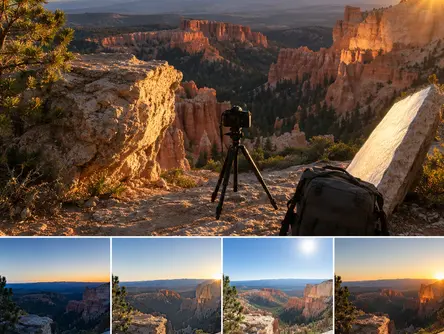
With that groundwork, write the day as a sequence of light events:
- Pre-dawn colour. Blue hour, when the sky carries the light and long exposure can smooth water or moving figures into tone.
- First hard sun. The moment direct light reaches the terrain, raking across texture and throwing long shadows.
- Open shade through the middle hours. Courtyards, north-facing lanes and interiors lit by bounced daylight.
- Last warm bounce. Late light reflecting off a sunlit surface into shaded ground, often brief and easy to miss.
Give each event a plausible working area without specifying its required subject. The area is a hypothesis about where the light will be interesting; what you photograph there stays open.
Then hold one flexible window with no subject assigned. A window of roughly 45 to 60 minutes is a reasonable scheduling allowance, though it is a planning convenience rather than any threshold for creativity. What matters is that it is long enough for leaving it empty to be a real option. If the window can only ever be filled, it is just another appointment.
The Photograph That Could Not Have Been Pre-Listed
Consider an imagined scene. The anticipated sunrise stays flat beneath cloud, a uniform grey lid over the overlook. Along the approach, though, wet paving catches a pale opening in the sky, while a doorway provides a dark edge beside it.
The photographer notices that tonal separation and begins working it. Moving laterally changes the alignment of the reflection against the foreground clutter, until the bright shape clears a drain cover. Lowering the camera changes how much reflective paving enters the frame and lengthens the reflection's form. Then comes the wait, for a passing figure to cross the bright patch and give the dark doorway a counterpart.
No list could have contained that picture. It depended on rain that had stopped recently, on a gap in the cloud and on a person who happened to walk by. It was available only to someone whose attention was not still fixed on the overlook.
Authentic voice, seen this way, is the pattern of choices that repeats when nothing is assigned: what a photographer frames once the obligation is gone. Over several days, those unassigned choices start to rhyme. One person returns again and again to reflected light; another to the spacing between figures; another to edges and thresholds.
The edit should honour that. Sequence the selection for how the day behaved, not for how closely frames resemble published icons. Compare adjacent exposures for subject separation and reflection shape before selecting the most immediately recognisable view. The recognisable frame will always feel safe at first glance, and that feeling is a poor guide to which picture actually carries the place.
Edit by the Light
Lay out a day's selects in the order the light occurred. Gaps and repetitions in that sequence reveal where your attention lapsed and where it was strongest.
Stop Scoring the Trip Against the Postcard
On your next self-directed photo tour, carry no iconic shot list at all. Not a shortened one, not a "just in case" page folded into the camera bag. Leave it at home.
Prepare instead a sequence of light events and a short set of questions about how the place behaves: where first sun lands, which walls return warmth into shade, when the streets fill and when they empty, what the weather habit is and how today departs from it. Plan each day around those questions and let the answers decide where you stand.
Treat any famous view as optional scenery rather than a debt owed to the brochure. If the overlook is beautiful at the hour you pass it, photograph it with the same attention you give anything else. If it is flat, walk on without guilt.
When you sit down to the final edit, apply one test to every frame: did this photograph depend on a circumstance you discovered there, such as a temporary reflection or a changing gap between people? Build the portfolio from the frames that pass, and let the postcard stay on the rack where it belongs.







Reader Comments
The conversation starts with you.
Your Comment